
Your questions about the Manuel Antonio night tour, thoughtfully organised. Explore prices, preparation, wildlife and the details of your experience at your own pace.
Prices, inclusions and choosing your experience.
There are two published options and both include the reserve entrance, the guide, the scope, the specialized lights, a flashlight per guest, free 4K photos and round-trip transport within the Quepos and Manuel Antonio corridor.
| Option | Adults 13+ | Children 3–12 | Format |
|---|---|---|---|
| Group Night Tour | $50 per person | $40 per person | Shared, after sunset |
| Private Night Tour | $75 per person | $65 per person | Your group only, flexible pace |
Children aged 3 to 12 pay $10 less than the adult price on either option. Food and drinks are not included on either one.
Because you are booking direct with the operator rather than through a marketplace, there is no platform commission built into those numbers, and the person who answers your message is the person organising your walk.
Everything you need to do the walk is in the price; everything you would consume is not.
Included: entrance fee · naturalist guide (English and Spanish) · Swarovski spotting scope · specialized guide lighting · one flashlight per guest · free 4K photos and video of your own tour · round-trip transport within Quepos and Manuel Antonio.
Not included: food and drinks · gratuities · anything outside the Quepos–Manuel Antonio transport corridor, which needs to be arranged separately when you book.
The free photos are worth calling out because guests mention them constantly in reviews. You are walking in the dark with a camera that will not cope; the guide’s will. You get the files afterwards at no charge.
Book the group tour at $50 unless one of four things is true, in which case the $75 private is worth the difference.
Take the private option if: you are travelling with young children and need to be able to stop or turn back; you are serious about photography and want the guide’s attention and the scope without queueing; you have a specific target species and want the route built around it; or you simply want to walk at your own pace without waiting for a group of strangers.
Otherwise the shared walk sees exactly the same forest with exactly the same guide, scope and lighting. The animals do not behave differently because you paid more. On a night when the forest is generous, the group tour is one of the best-value things you can do in Manuel Antonio.
Message us on WhatsApp and we confirm your date, your pickup point and your start time directly, usually within minutes.
Book the Manuel Antonio night tour on WhatsApp → +506 8514 1361
If you are planning a December trip and want the whole thing — park date, night walk, transport — laid out on one page, start with our December Manuel Antonio tour booking guide.
Booking direct means no marketplace commission sits between you and the guide, and it means the confirmation, the pickup and the photos all come from the same people.
Photos, prices and the quick version of this walk are also on manuelantonionighttours.com. Staying in town? Our Quepos guide lists what else to do around the night tour.
Pickup, timing and what to bring.
Transport is round-trip and included within the Quepos and Manuel Antonio corridor, and your exact pickup point and time arrive in a welcome message immediately after you book — we do not publish a single fixed GPS pin for this tour, because the pickup is built around where you are staying.
That corridor is small. The whole strip from Quepos town down the Manuel Antonio road to Playa Espadilla is about seven kilometres end to end, so wherever your hotel sits on it, the drive is short. If you are staying outside that corridor — Dominical, Uvita, Jacó, Ojochal — say so when you book and we will quote the transfer separately rather than surprise you with it.
The walk starts after sunset and runs 2.5 hours on the trails.
The start time moves through the year with sunset, which in Manuel Antonio sits close to 5:30 p.m. and does not swing much — Costa Rica is nine degrees off the equator, so the evenings are remarkably consistent. Your exact start time comes in the welcome message with the pickup details, because it is set against sunset on your specific date rather than against a fixed clock.
The current tour information estimates a return to your hotel around 7:30–8:30 p.m. Confirm the exact start, pickup and return time for your date with Wakoo Tours.
Closed walking shoes with grip, long trousers, insect repellent and a light rain layer cover everything that matters; everything else is optional.
You do not need to bring a flashlight. One is handed to every guest.
Species, equipment and discoveries after sunset.
The species you have the best odds of seeing are red-eyed tree frogs, two-toed sloths, kinkajous, several snake species and an enormous cast of insects and spiders — and the order in which they appear is fairly predictable, because nocturnal animals keep a schedule.
Here is how a night usually unfolds. We do not guarantee any of it. On some nights the forest is generous and on some nights it is quiet, and a guide who tells you otherwise is guessing on your behalf.
The walk starts in the blue hour, when there is still enough light to see the trail without a beam. This is when the forest handles its shift change: the day insects go quiet and the night ones start. Katydids, stick insects, winged grasshoppers, glass-winged moths, rhinoceros beetles and the big orb-weaver spiders that rebuild their webs at dusk. Your guide will stop at a web that was not there an hour ago and show you the spider finishing it in real time.
Most visitors arrive thinking the insects are the boring part of the tour. Most visitors leave saying the insects were the surprise. A leaf-mimicking katydid seen at ten centimetres under a good light is a better photograph than a distant monkey.
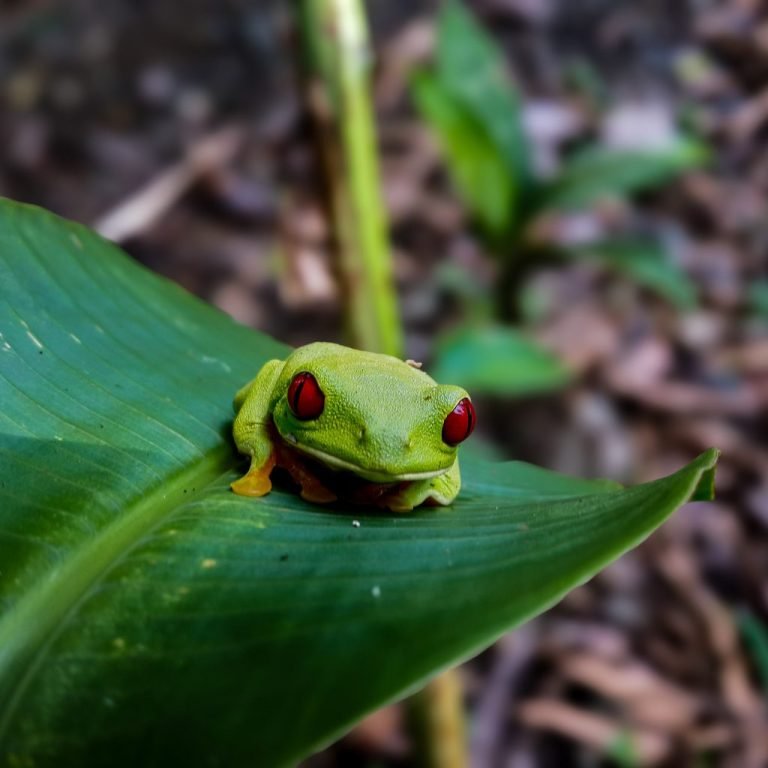
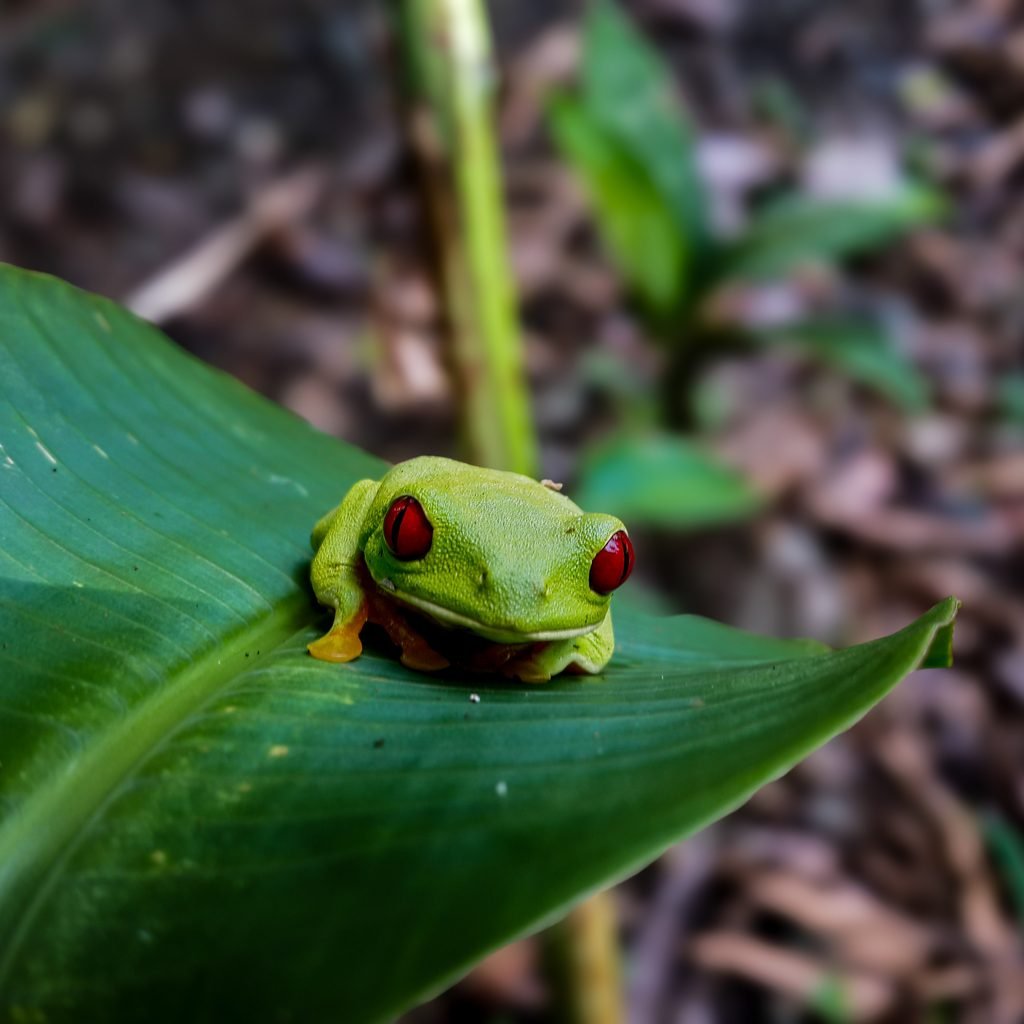
The red-eyed tree frog (Agalychnis callidryas) is the animal most people came for, and the honest odds depend almost entirely on water and rain. They congregate near still water and they call after rain, which is why a drizzly December night is a better night for frogs than a dry one — the opposite of what most travellers assume when they check the forecast and worry.
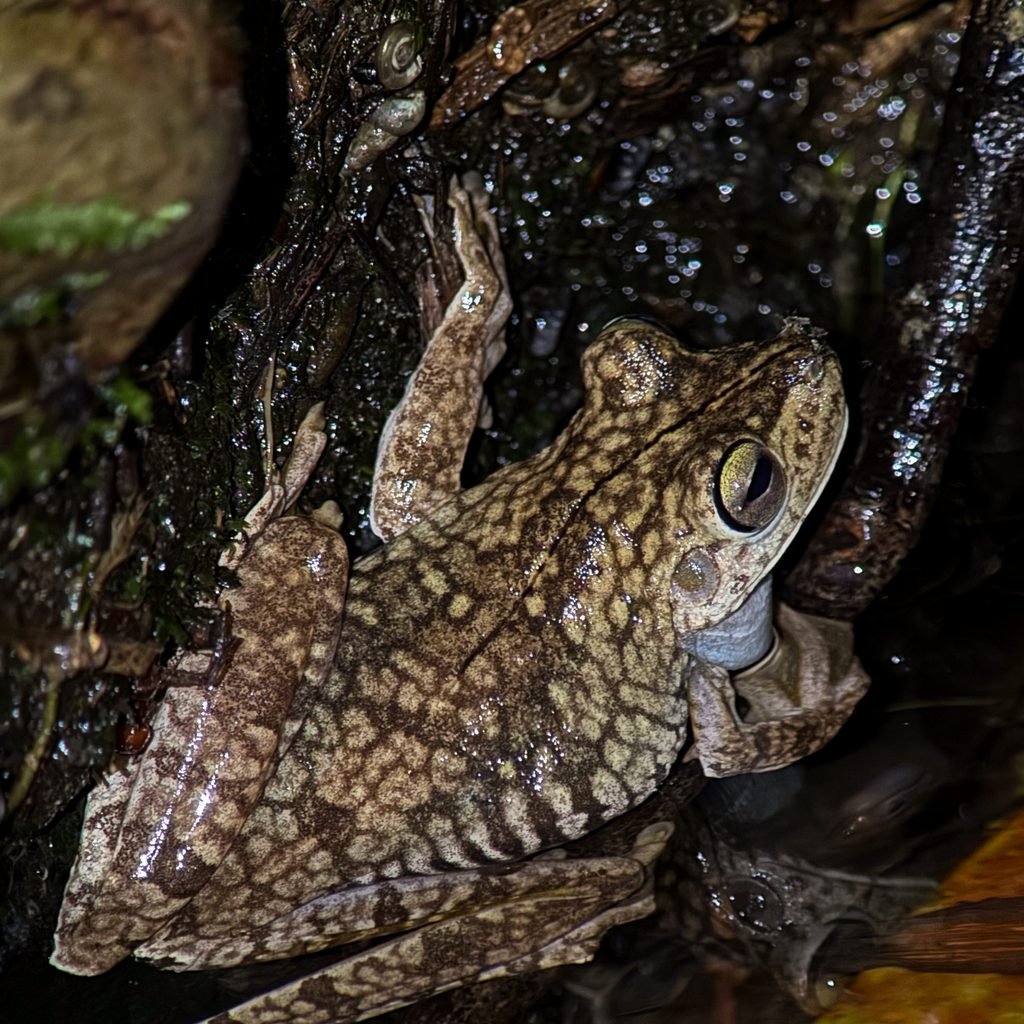
Beyond the red-eyed, the usual cast includes the milk frog, the masked tree frog, glass frogs on the underside of leaves over running water, and the small leaf-litter frogs you hear constantly and see rarely, plus the gladiator treefrog, which calls from ponds and gets its name from the spur on the male’s thumb used in territorial fights. Your guide finds them by ear first and by light second. This is the part of the walk where you learn that a naturalist hears the forest before he sees it.
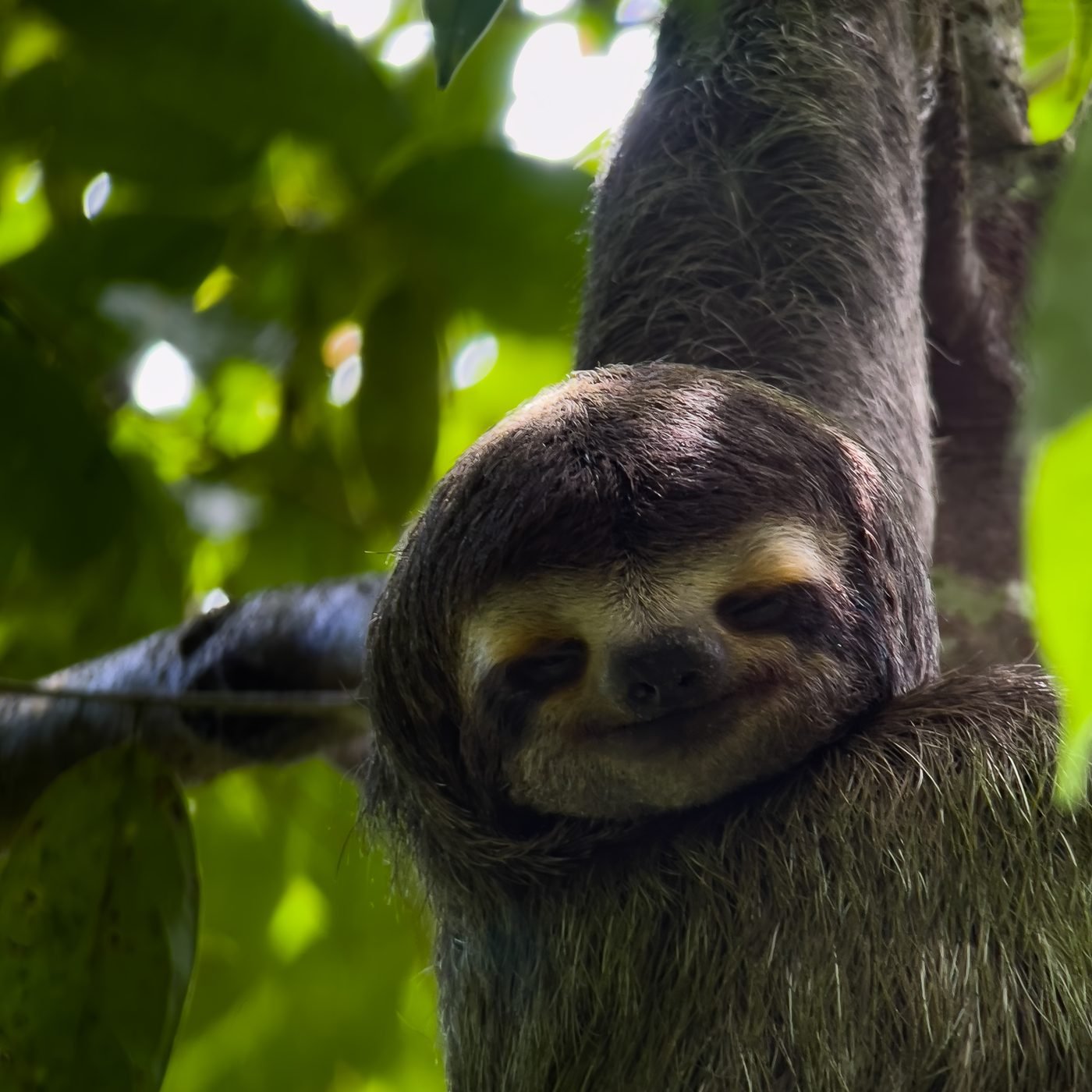
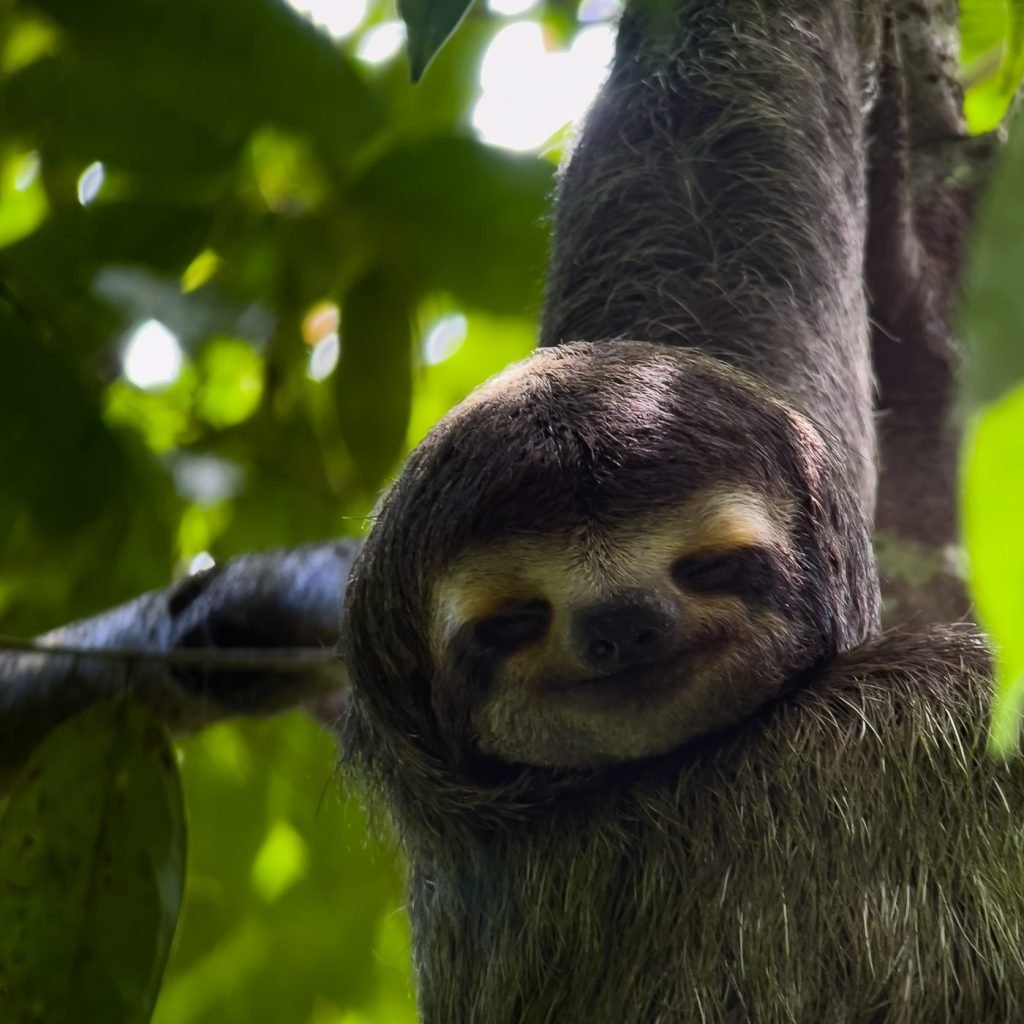
The two-toed sloth (Choloepus hoffmanni) is the reason to walk at night rather than during the day. The three-toed sloth you see on a daytime tour is mostly asleep. The two-toed is nocturnal: at night it is awake, moving, eating, and doing the one thing tourists never get to photograph in daylight. Odds on a given night are good but not certain.
The kinkajou is the prize. It is a golden, prehensile-tailed relative of the raccoon that lives in the canopy, feeds on fruit and nectar, and is essentially never seen during the day. Spotting one is a matter of scanning the fruiting trees and catching eyeshine. Some weeks we find them on most nights; some weeks we do not. When we do, the Swarovski scope turns a distant shape into a face.
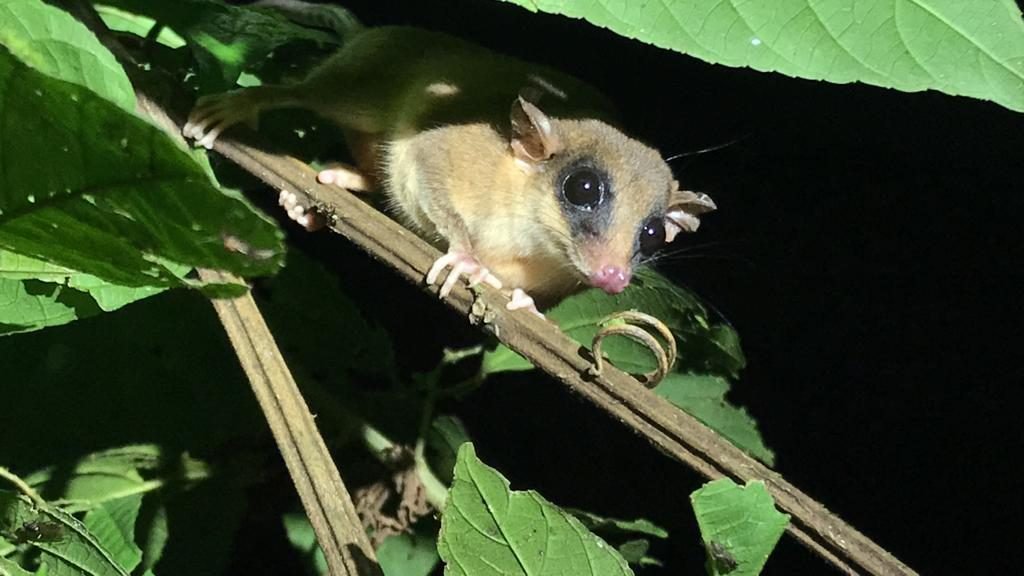
Other mammals that turn up: opossums, bats around the open areas, and occasionally a night-active porcupine. Howler monkeys are heard far more often than they are seen after dark.
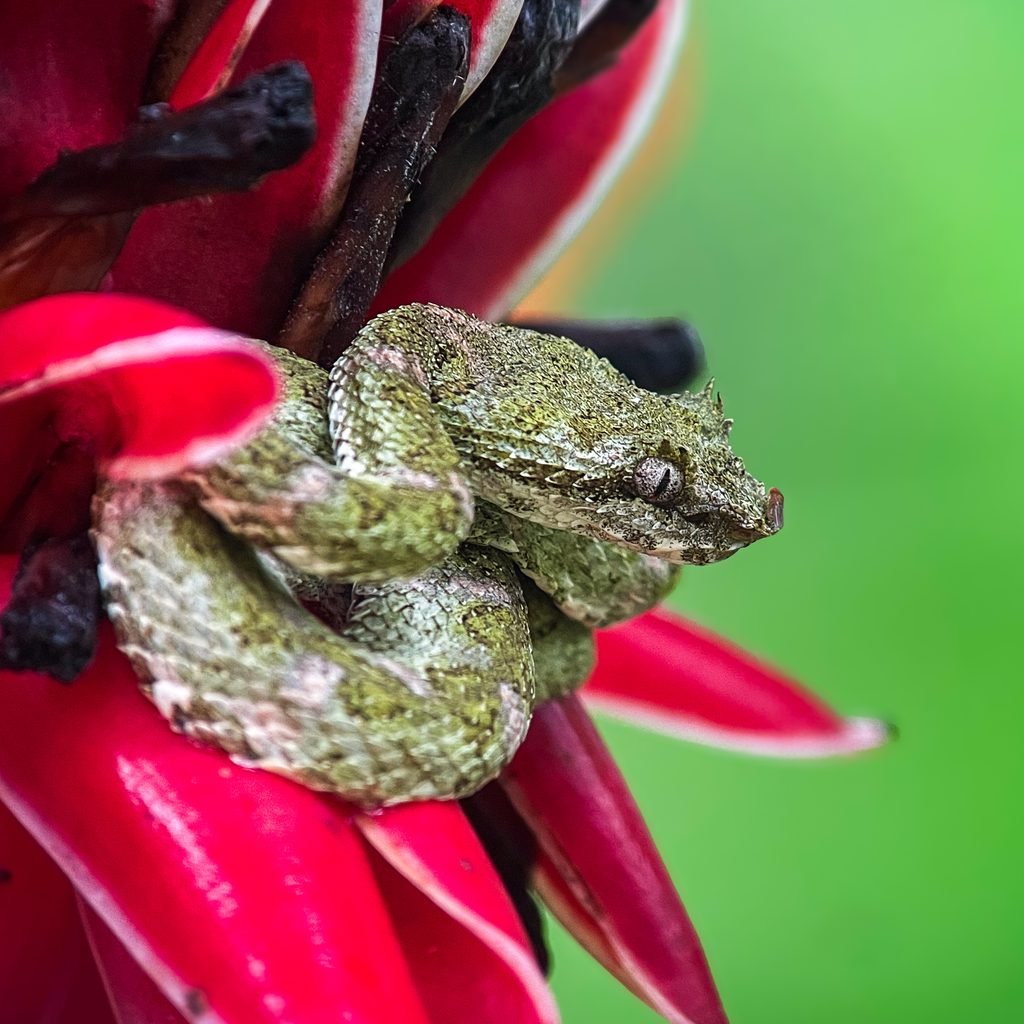
Snakes are seen on a good proportion of nights and they are the species travellers ask about most nervously. The common finds are the cat-eyed snake hunting frogs near water, the parrot snake, the blunt-headed tree snake draped over a branch, and — with real luck and from a safe, guide-controlled distance — an eyelash viper, which is the most photogenic snake in Costa Rica and one of the few venomous ones you might meet.
Nobody touches a snake on this tour. Your guide positions the group, sets the light, and you photograph from where he tells you to stand. In practice the risk on a guided night walk is lower than the risk of the drive to the trailhead.
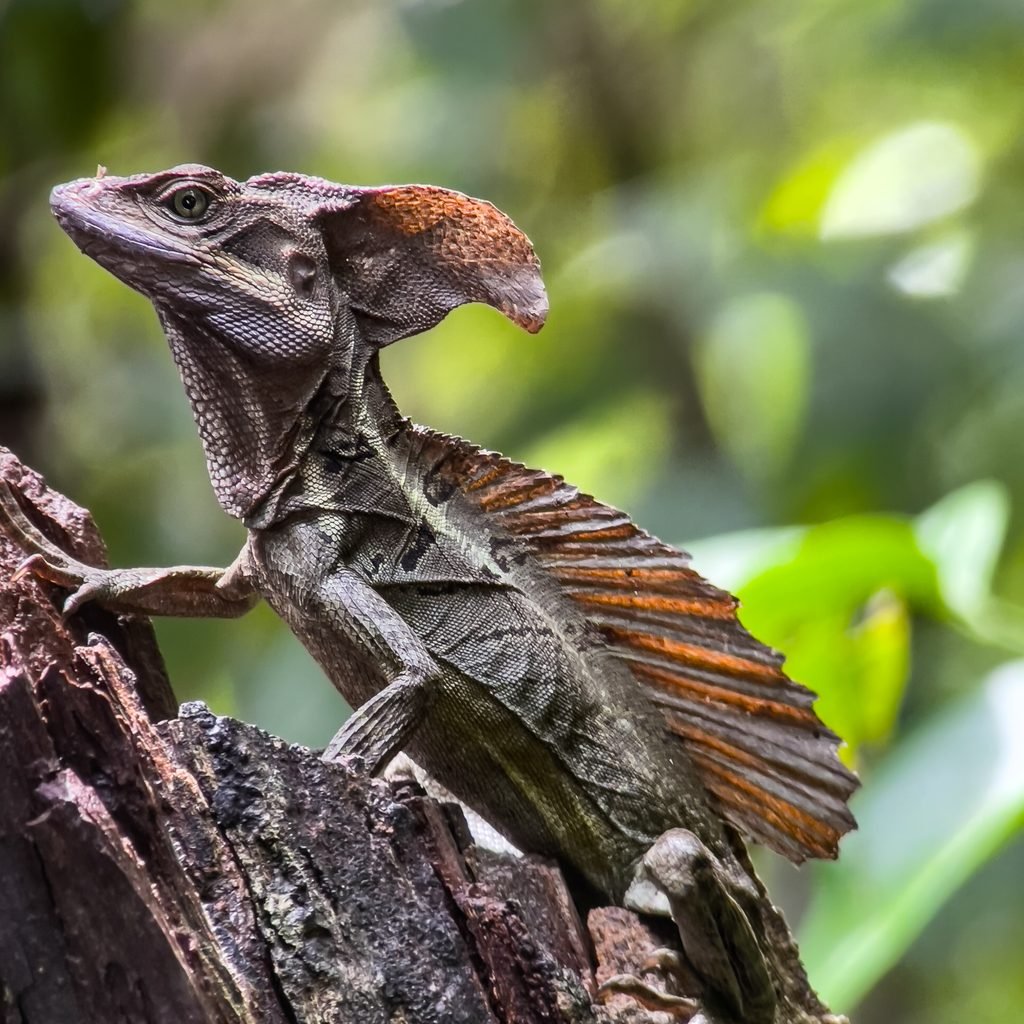
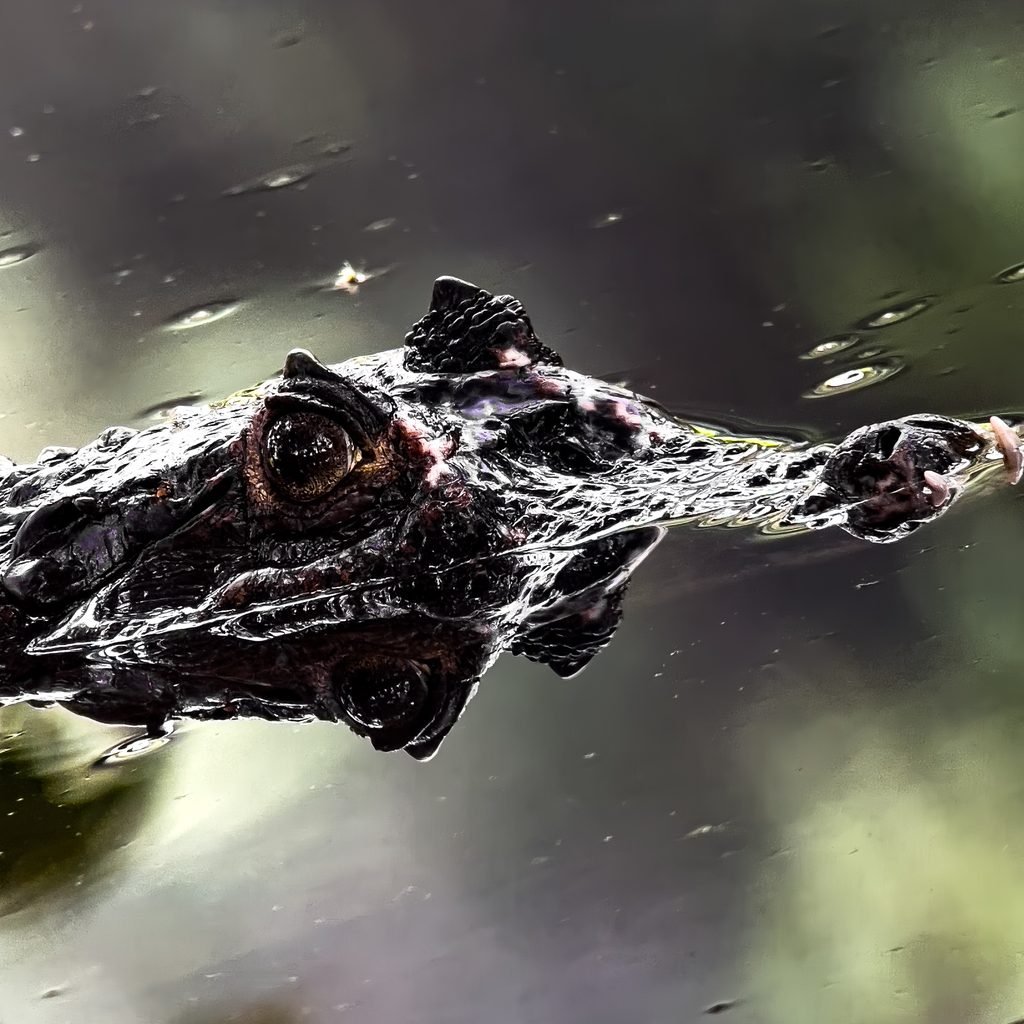
Two more reptiles turn up regularly, and travellers usually ask about both by nickname rather than their real one. The common basilisk (Basiliscus basiliscus), nicknamed the “Jesus Christ lizard” for its ability to sprint across the surface of water, sleeps on low branches over streams and is one of the easier finds for a guide who knows where to look with a light. The spectacled caiman, a small crocodilian, shows up in the reserve’s ponds and slow water on a regular share of nights.
The equipment is the difference between walking through a dark forest and seeing one, and on this tour it is included rather than rented: a Swarovski spotting scope, specialized guide lighting, and a flashlight handed to every single guest.
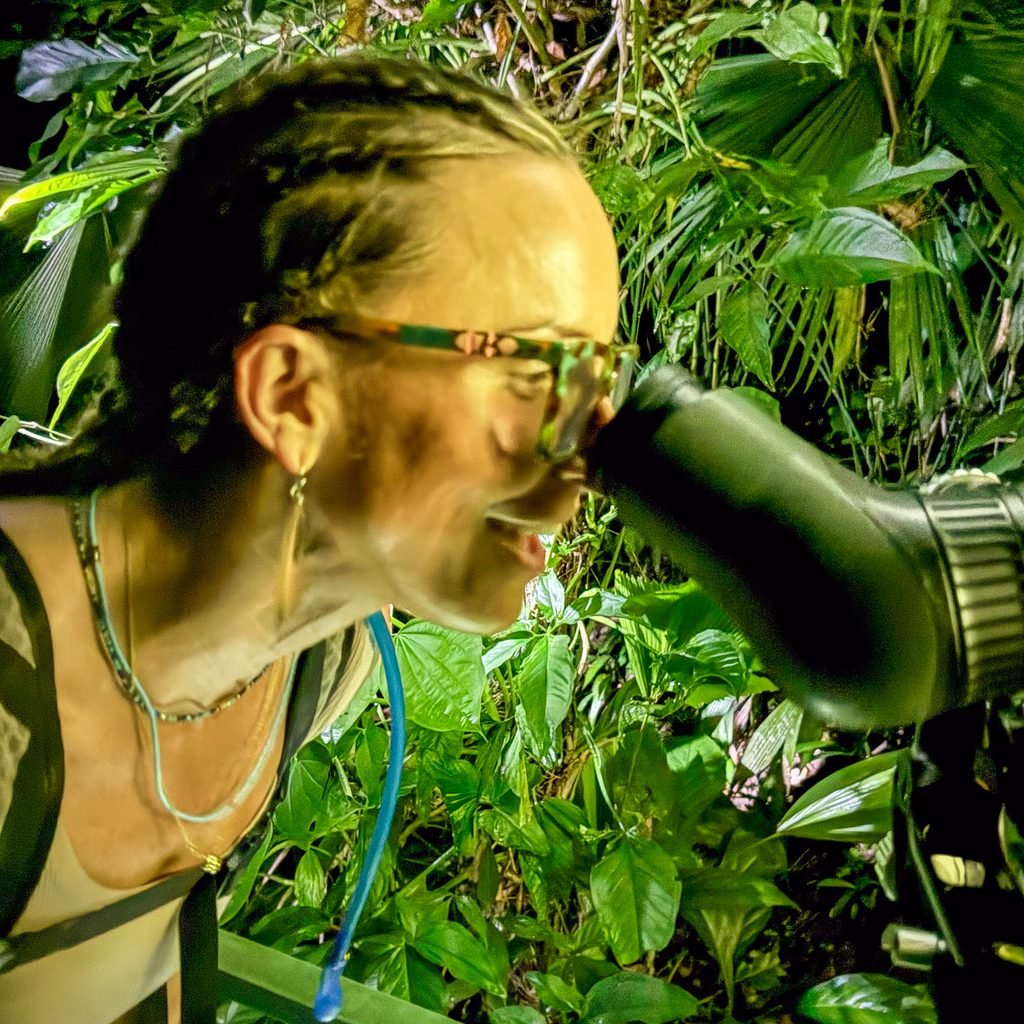
The scope matters because most of what happens at night happens ten to twenty metres up. A kinkajou in a fruiting tree is a shape to the naked eye and an animal through the scope. Your guide will line the scope up and let every person in the group look, and then hold a phone to the eyepiece so you leave with the photo.
The lighting matters differently. Guide-grade lights are used sparingly and deliberately — a wide low beam to scan, a focused beam only once the animal is identified and only for as long as the photograph takes. That is a welfare decision as much as a photographic one. A phone torch waved around the canopy finds nothing and stresses everything.
And every guest carries their own flashlight, which sounds minor until you are on a root-crossed trail in the dark. You are not following the one person with the light.
Rain, park closures, tickets and ages.
Yes — the tour runs in the rain, and rain is genuinely good for the wildlife you came to see.
Amphibians are the clearest case: frogs call and move after rain, so a wet night raises your odds on red-eyed tree frogs rather than lowering them. Insect activity rises too. The only thing rain reduces is canopy visibility for the mammals, and that is a partial trade, not a cancellation.
We cancel only for genuinely unsafe conditions — electrical storms or flooding on the access route — and if we cancel, you are not charged. The decision is made by the operator on the day, not by the forecast a week out. If you are watching a rainy forecast from home and wondering whether to cancel, the answer is no.
Yes. Manuel Antonio National Park is closed every Tuesday, and there are nine of them across December 2026 and January 2027 — December 1, December 8, December 15, December 22 and December 29, 2026, and January 5, January 12, January 19 and January 26, 2027 — and the night tour operates normally on every one of them, because it does not run inside the national park.
This is the most useful sentence on this page for anyone planning a trip. A Tuesday in Manuel Antonio is the day people discover their main plan is unavailable, usually the night before. The night walk is not affected: different land, different permit, different operator, and it happens after dark on a day the park was never open anyway.
The park also closes to the public at 4:00 p.m. every day of the week. So even on an open day, the evening is free. Doing the park in the morning and the night walk after sunset is the standard way to get two completely different forests out of one date.
No. SINAC tickets are for entering Manuel Antonio National Park during the day, and the night tour does not enter the park, so no SINAC ticket is required and no SINAC booking window applies to it.
This is worth understanding because the SINAC system is the biggest source of planning stress in Manuel Antonio. Park tickets are sold through the government platform on a rolling window of roughly two months ahead, daily capacity is capped, and high-season dates sell out. Travellers plan their whole trip around that window.
The night tour sits completely outside it. Your reserve entrance is included in the price we quote you, and availability is our own. If your park date is locked to a specific morning because that was the only SINAC slot left, the night walk flexes around it instead of competing with it.
Children from age 3 can join (ages 3–12 pay $10 less), and closed shoes with grip are required. It is a guided walk on maintained trails with a certified guide and a flashlight per person, and the practical risk is close to that of any evening walk on uneven ground.
On snakes specifically: yes, you may see one, and that is the point rather than the hazard. Nothing is handled, the guide sets the viewing distance, and venomous species are treated as photography subjects at range. In years of running this walk the snakes have been the highlight of the reviews, not the complaints.
On children: the tour has a children’s price starting at age 3, so young children are welcome, but be realistic about a 2-hour walk in the dark past a small child’s bedtime. Families with children under six usually have a better night on the private option, where the pace is yours and turning back early costs nothing.
Where the walk happens and how it differs.
It is a 2-hour guided walk after sunset — not inside the national park, because the park closes to the public at 4:00 p.m. every single day and no operator on earth has permission to walk visitors through it at night.
That distinction matters more than any other fact on this page. When travellers search for a Manuel Antonio night tour, most of them assume they are booking a night walk inside the national park. They are not, and any listing that implies otherwise is selling something that does not exist. What they are booking — what we run — is a night walk through the same coastal rainforest ecosystem, on private land where night access is legally permitted and where the trails have been cut and maintained for exactly this purpose.
In practice the forest does not know where the park boundary is. The frogs, the kinkajous, the sloths and the snakes move across it freely. The difference between the reserve and the park at 7:00 p.m. is not biology, it is paperwork.
These are three different products and travellers mix them up constantly.
The Manuel Antonio night tour — this page — is a walk on foot through rainforest trails after sunset, $50 shared or $75 private. “Jungle night walk” and “night walk” are the same tour under different names.
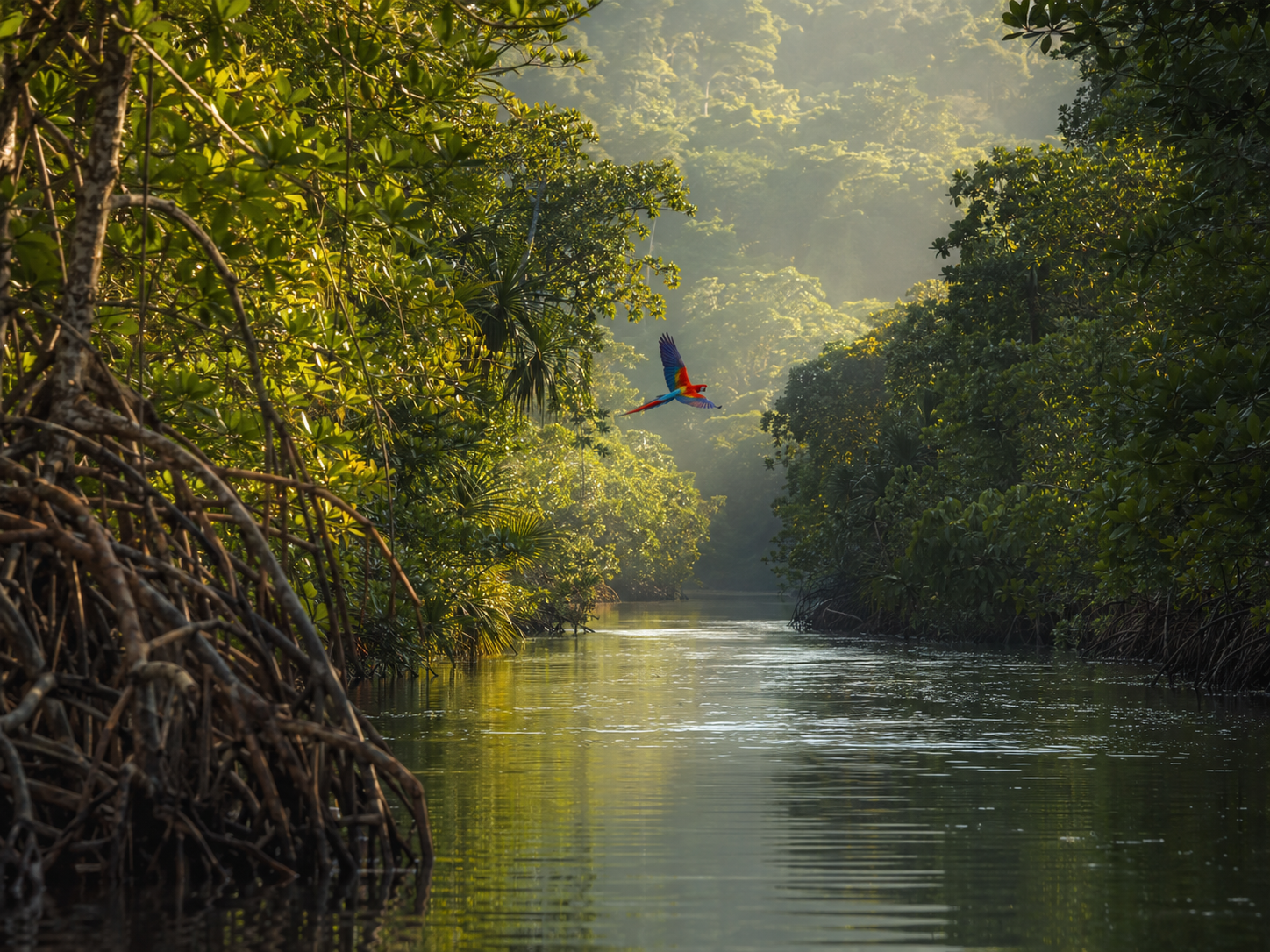
A mangrove or night boat tour is a different ecosystem entirely: the Damas estuary, by boat, roughly two hours, different species — crocodiles, boa constrictors, mangrove birds, silky anteaters. If you want water and a boat, that is the one.
A herping tour is a night walk with the species emphasis pushed hard toward reptiles and amphibians. On the private option you can simply tell your guide that is your priority and he will route the walk that way, which is cheaper than booking a specialist product.
Because the majority of the rainforest’s animal activity happens after the park has closed and almost every visitor to Manuel Antonio sleeps through all of it.
Most people do the national park in the morning, see the three-toed sloths asleep and the capuchins working the trail, and go home thinking that is the forest. It is half of it, and arguably the quieter half. The frogs, the kinkajous, the snakes, the two-toed sloths and the insects that make the noise you hear from your hotel balcony are all on the other shift.
The night tour currently holds a 4.9/5 · 3,000+ reviews, and the thing reviewers mention most often is not a single species — it is the surprise that the second walk was better than the first.
Written by the Wakoo guide team, led by Jason Solano Zamora, ICT-licensed naturalist guide with 18 years in Manuel Antonio.
Tell us your dates and who is travelling.
Let’s find the right experience for you.