
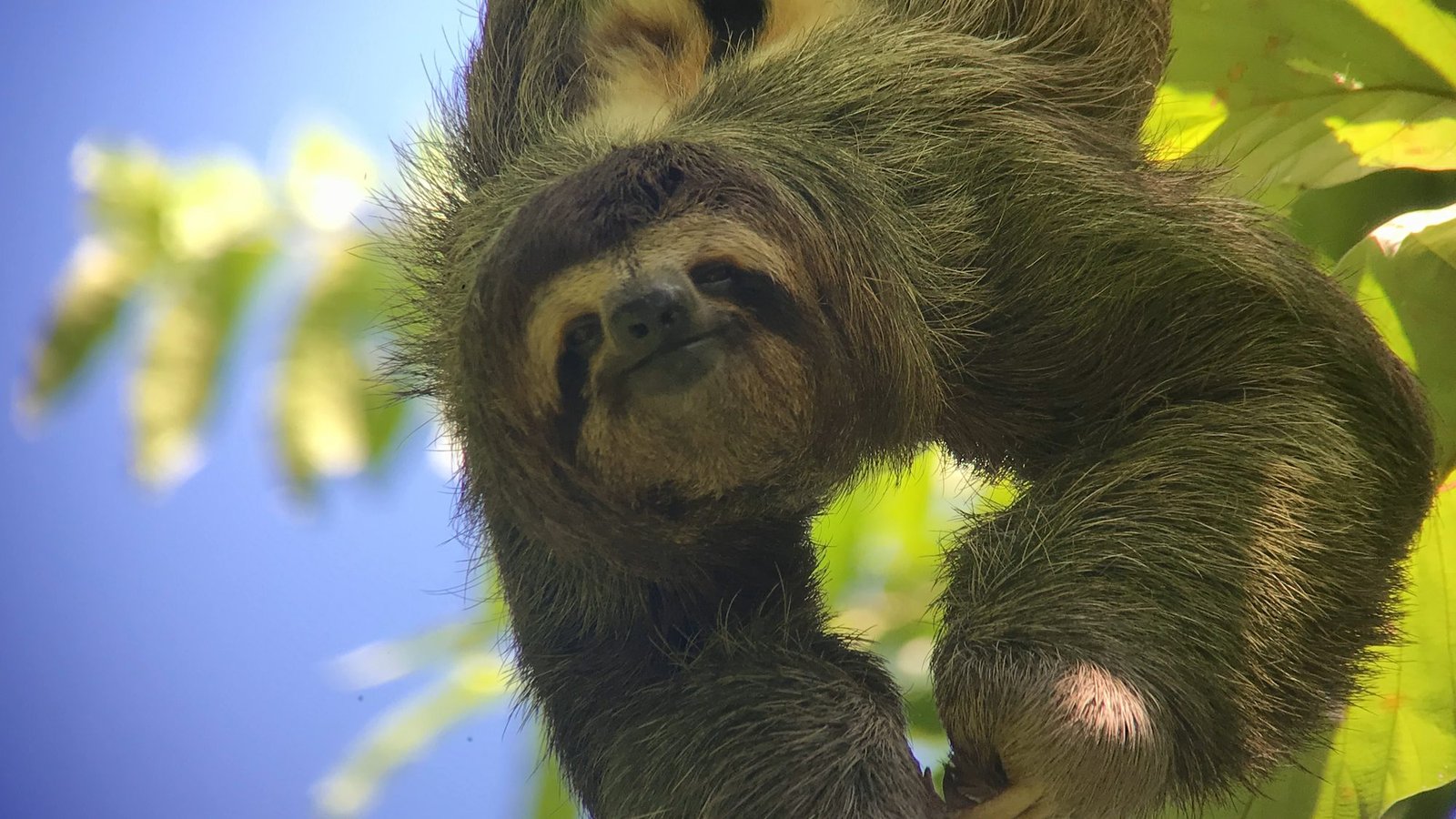

For most travelers coming from the U.S., there’s one animal at the very top of the Costa Rica bucket list: the sloth. And there’s no better place to check that box than Manuel Antonio, one of the most sloth-dense national parks on the planet. But here’s the catch nobody tells you before you arrive — sloths are masters of hiding in plain sight. This guide covers exactly where to look, when to go, and how to make sure you actually see one instead of walking right past it.
Which Sloths Live in Manuel Antonio?
Manuel Antonio is home to two different sloth species, and knowing the difference changes how — and when — you’ll find them.
Three-toed sloth (Bradypus)
The famous "smiling" sloth with the black mask around its eyes. Three-toed sloths are diurnal, meaning they’re active during the day, which makes them the ones most visitors spot on a morning hike. They love the leaves of the guarumo (cecropia) tree, so those tall, umbrella-shaped trees are prime real estate.
Two-toed sloth (Choloepus)
Larger, shaggier, and nocturnal. Two-toed sloths sleep curled into a ball high in the canopy during the day and come to life after dark. If seeing this species is your goal, a night walk outside the park is your best shot.
Fun fact worth sharing on Instagram: both species grow algae in their fur, which acts as camouflage and even provides extra nutrients. It’s a big reason they blend so perfectly into the canopy.
Best Time to See Sloths in Manuel Antonio
Timing matters more than luck. Here’s what actually works:
- Time of day: Early morning (7:00–10:00 AM) is the sweet spot for three-toed sloths, when they’re most active and the park is coolest. Late afternoon (3:00–5:00 PM) is a solid second window.
- Time of year: Sloths are here year-round, but the dry season (December–April) offers clearer canopy views and easier hiking. Green season still delivers — you’ll just want a guide who knows where they’re feeding that week.
- Day of the week: Manuel Antonio National Park is closed every Tuesday. Plan around it. Entry slots (7:00, 7:30, 10:00 AM, 12:30, 1:00 PM) fill up in high season, so book ahead.
Where to Look: The Sloth Trail
The best-known spot inside the park is Sendero El Perezoso — literally "The Sloth Trail." This flat, accessible path runs parallel to the main trail and is famous for sightings. Keep your eyes up in the treetops, especially in the guarumo trees. Sloths look like a knot of wood or a termite nest, so scan slowly for a patch of fur or the slightest movement.
Why You Really Need a Guide (and a Scope)
Here’s the honest truth: solo visitors spot only 20–30% of the wildlife that’s actually around them. A certified naturalist with a high-powered spotting scope pushes that success rate to 70–95%.
Sloths spend their days motionless and curled up 30 meters above your head, perfectly camouflaged. A trained guide knows which trees they favor, reads the subtle signs, and — this is the part travelers rave about — sets up a scope so you can see the sloth’s face, claws, and even a baby clinging to its belly in crisp detail.
At Wakoo Tours, every guided Manuel Antonio National Park tour goes out with a Swarovski spotting scope and an ICT-certified naturalist who grew up right here. And because a photo through the scope is unbeatable, we send you free 4K photos and video of everything you saw — no upsell, no watermark. For couples and families who want the canopy to themselves, our private VIP wildlife tour includes park entry and pro photography.
Beyond Sloths: What Else You’ll See
Once you’re scanning the canopy with a guide, sloths are just the beginning. Manuel Antonio delivers:
- White-faced capuchin and squirrel monkeys (the endangered mono tití)
- Keel-billed and fiery-billed toucans high in the canopy
- Iguanas, agoutis, and coatis along the trails
Serious birders can go deeper on a dedicated birdwatching tour, and wildlife lovers who want a completely different ecosystem can add the Damas mangrove tour — a boat ride where sloths, monkeys, and caimans line the waterway.
Ready to Meet a Sloth?
Seeing a sloth in the wild is one of those travel moments you’ll talk about for years. Give yourself the best odds: come early, plan around Tuesday’s closure, and go with a local naturalist who can put one in the scope for you. Every Wakoo tour also donates $2 per guest to local kids through Kazan Karate for Kids — so your bucket-list moment gives back, too.
Have questions about which tour fits your trip? Message us on WhatsApp — we reply in under 2 minutes, in any language.
Guide: Jason Solano Zamora, ICT-certified naturalist guide and founder of Costa Rica Wakoo Tours.
Are you guaranteed to see a sloth in Manuel Antonio?
No honest guide will promise you a sloth, and you should be suspicious of any operator who does. What the numbers support is a very high probability: Manuel Antonio holds one of the densest sloth populations of any park in Costa Rica, and a guided group walking with a certified naturalist and a spotting scope finds at least one sloth on the large majority of mornings. Wildlife is wild. What a guide changes is the odds, not the certainty — a solo visitor scanning the canopy with the naked eye is working at roughly 20–30% of what is actually above them, while a trained eye with optics works at 70–95%.
How long does it take to find a sloth in the park?
On a typical guided morning the first sloth usually turns up within the first 30 to 45 minutes, most often along Sendero El Perezoso, the flat trail named after the animal. That is an average, not a rule. Sloths descend from their tree roughly once a week to defecate and otherwise stay put for days, so a troop of guides working the park shares sightings by radio: when one guide locates a sloth at 7:15 AM, that same animal is usually still findable at 9:00 AM. This is why the earliest entry slots — 7:00 and 7:30 AM — consistently produce the best results.
Can you see sloths in Manuel Antonio in December?
Yes. Sloths do not migrate and do not hibernate, so December is as good as any month, and in some ways better: the dry season begins to settle in, the canopy is clearer, and the guarumo trees the three-toed sloths feed on are easier to scan. The thing to plan around in December is not the sloths, it is the calendar. Manuel Antonio National Park is closed every Tuesday — in December 2026 that means the 1st, 8th, 15th, 22nd and 29th, and in January 2027 the 5th, 12th, 19th and 26th. December is also the busiest month of the year and entry slots sell out, so the date you want is the date you have to reserve in advance. If December is your window, book your December Manuel Antonio tour and lock the morning slot before the season fills.
Do sloths actually move during the day?
They do, just slowly enough that most visitors miss it. A three-toed sloth travels an average of about 40 metres a day, feeding on leaves and shifting position in the crown of a tree. Through a scope you will usually see an arm reach, a head turn, or the slow rotation of the neck — three-toed sloths can turn their heads roughly 270 degrees, which is how they scan for predators without moving their bodies. The two-toed sloth is the one you are unlikely to see moving at all in daylight, because it is nocturnal and spends the day curled into a ball that genuinely looks like a termite nest from the ground.
Can you touch, hold or feed a sloth?
No, and this matters. Touching, holding or feeding wildlife is prohibited inside Manuel Antonio National Park, and handling a sloth causes it real stress — their heart rate and body temperature are tightly regulated and both spike when they are handled. Any business in Costa Rica offering to let you hold a sloth is operating outside the law and outside of animal welfare standards. The legitimate close-up is optical, not physical: a Swarovski scope brings the animal’s face, claws and any baby clinging to its belly into full detail from 30 metres below, and every Wakoo guest is sent free 4K photos and video of what the scope saw.
Do you need your own binoculars to see sloths?
You do not need to buy anything. Binoculars help, and if you already own a pair they are worth carrying. But the equipment that changes the experience is the spotting scope, and it comes with the guide — a scope at 20–60x magnification is not something visitors carry themselves, and it is the difference between confirming “that dark shape is a sloth” and actually watching the animal’s face.
Which Manuel Antonio tour is best for sloths?
The Manuel Antonio National Park guided tour is the one built for this. It runs in the early-morning window when three-toed sloths are active, it goes out with an ICT-certified naturalist who grew up in this region, and it carries the Swarovski scope. Group departures start at $30 per person for guiding; private and VIP options exist for guests who want their own pace and their own guide. Park entrance is separate where it is not included — SINAC charges $18.30 per adult and $5.65 per child. If you want the two-toed sloth as well, add the night walk: it is the only realistic way to see the nocturnal species awake.
Planning ahead? Book your December Manuel Antonio tour and lock your date before the season fills.
0 Comment