
Is Manuel Antonio National Park Safe?
Short answer: yes. Manuel Antonio National Park is one of the safest places you will visit in Costa Rica — it is a fenced, ranger-patrolled protected area with a daily visitor cap, one entrance and staff on the trails. In more than a decade of guiding inside the park, the problems we see are never violent crime. They are four things: the ocean at Playa Espadilla, animals taking food out of open bags, unattended belongings on the sand, and fake guides working the sidewalk outside the gate. This page explains each one and exactly what to do about it, with no scare stories and nothing invented.
Is Manuel Antonio safe for tourists in 2026?
Yes — for tourists, the park itself is low risk, and the risk that exists is concentrated outside the fence, not inside it.
Inside the park you have park rangers (SINAC staff), marked trails, a single controlled entrance where every ticket is scanned, and a legal cap on daily visitors. Everyone on the trail has been counted. That is not true of the road, the public beach or the parking lots outside, which are ordinary public space in a busy tourist town. So the honest framing is: the park is safe; the 400 metres before the park is where you need your head up.
What we tell every guest before we start walking: carry only what you need, keep your phone in a zipped pocket instead of your hand, and never leave a bag on the sand while you swim. Do those three things and the statistical risk of your day drops to almost nothing.
Theft on the beach: what actually gets stolen in Manuel Antonio
What gets stolen is almost always an unattended bag left on the sand while its owner is in the water — not something taken from a person.
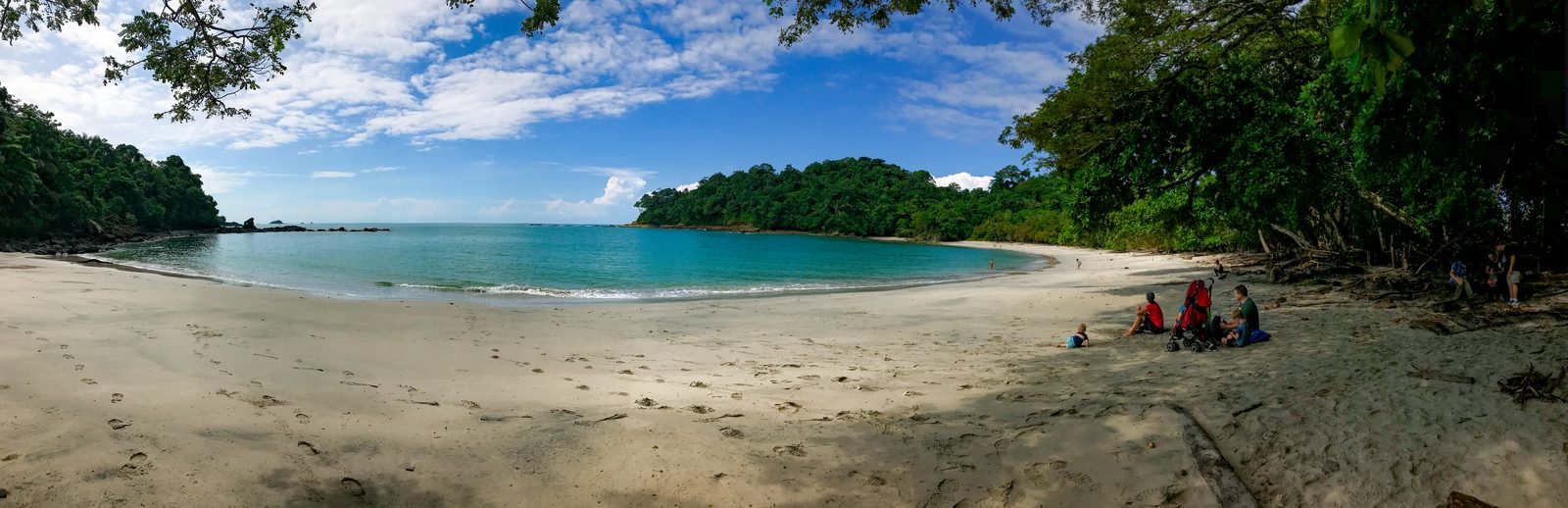
Playa Manuel Antonio, the protected cove inside the park, is where visitors swim, and the pattern is the same every week: a group drops backpacks, towels, phones and a wallet on the sand and walks 40 metres into the water where they cannot see their things. Some of those bags are opened by raccoons and monkeys (far more often than by people), and some are gone through by a person who walked in with a legitimate ticket.
The fix is boring and it works: one person stays with the bags, or the bags stay in sight and closed. Leave your passport in the hotel safe — you do not need it to enter the park, only your ticket. Bring the minimum: one card, a little cash, your phone, water, sunscreen.
Monkeys and raccoons stealing food inside the park
This is the single most common “robbery” inside Manuel Antonio, and it is done by animals — white-faced capuchin monkeys and raccoons that have learned that a tourist backpack contains food.
They are fast, they work in groups, and they will unzip a bag while you are looking at a sloth. A capuchin can open a daypack in seconds. Raccoons are bolder still and walk right up on the beach in the middle of the day.
Two rules. First, SINAC prohibits bringing food into the park — that rule exists precisely because fed animals become aggressive and sick, so obeying it protects you and them. Second, never feed them, and never hold food out for a photo. A capuchin that associates humans with food is the one that eventually bites someone, and a bite in a national park means ending your trip in a clinic in Quepos instead of on the trail. If an animal approaches your bag, stand up, close the bag and step away. Do not pull the bag back and forth with a monkey.
Riptides and currents at Playa Espadilla: the real danger
If there is one genuine physical danger in Manuel Antonio, it is the water at Playa Espadilla Norte — the long public beach outside the park, not the cove inside it.
Espadilla Norte has strong and unpredictable rip currents and a documented history of drownings. It is one of the few beaches in Costa Rica that has lifeguards for exactly that reason: the tower is staffed roughly 8 a.m. to 5 p.m. and flies warning flags when conditions turn. As recently as April 2026 a 20-year-old swimmer was swept out by the current there and rescue teams had to search for him. That is not a story to frighten you; it is the reason we say what we say.
Practical version: look at the flag before you get in, swim in front of the lifeguard tower and not at the far ends of the beach, and if you feel yourself being pulled out, do not swim straight back at the shore — swim parallel to the beach until the pull stops, then come in. Playa Manuel Antonio inside the park is a protected horseshoe cove with far gentler water, and it is the beach we recommend for families and for anyone who is not a confident swimmer.
Is it safe to hike the trails alone in Manuel Antonio?
Yes, the trails are safe to walk alone — they are wide, well marked, patrolled and busy — but walking alone costs you most of what you came to see.
There is no getting lost in Manuel Antonio: the main trail is a clear path, there are signs at every junction, and you are never far from other people or from a ranger. The risks of walking alone are ordinary ones: heat, dehydration, and a slick descent after rain. Wear shoes with grip, carry water, and start early.
The real cost is different. The animals in Manuel Antonio are small, still and camouflaged. A sloth 25 metres up in a cecropia tree looks exactly like a termite nest. Without a trained eye and a spotting scope, most visitors walk the whole trail and see monkeys, lizards and nothing else. Guides are not a safety purchase here — they are a seeing purchase.
Is Manuel Antonio safe for a woman traveling solo?
Yes. Manuel Antonio is one of the more comfortable places in Costa Rica for a solo female traveller, and the park itself is among the safest parts of it.
Inside the fence you are in a controlled, staffed, busy area in daylight with a lot of families around. The normal advice applies to the town rather than the park: use official taxis (red with a yellow triangle) or a booked transfer rather than an unmarked car, do not walk the unlit stretches of the main road alone after dark, and keep your drink with you. Joining a small guided group is also, in practice, the easiest way to spend a day in the park with company — you walk with a guide and a handful of other visitors instead of alone.
Is Manuel Antonio National Park safe for kids?
Yes — it is the most kid-friendly national park in Costa Rica, and that is mostly because the walking is easy and short.
The main trail to the beaches is a gentle, mostly flat path, not a mountain hike, and our tour spends about two hours inside the park (about 2.5 hours door to door), which is roughly the attention span of a seven-year-old in the heat. Playa Manuel Antonio is a calm cove for swimming. Park entry for children aged 2 to 12 is $5.65, and under 2 is free.
The things to actually manage with kids: the heat (go in the morning, bring water and a hat), and the animals. Tell children before you go in that they must not feed the monkeys or the raccoons and must not touch anything. A child holding a snack is the single most likely person in your group to have a close encounter with a capuchin.
Fake guides at the entrance: the scam nobody warns you about
This is the most common way visitors lose money in Manuel Antonio: people working the sidewalk outside the entrance who are not certified guides and who sometimes wear clothing that resembles an official park uniform.
The pattern is documented by multiple travel sources and it is exactly what we see every morning. Someone approaches you before the gate, offers a guided tour or “tickets”, and either overcharges you, sells you something the park does not actually sell that way, or walks you to a parking area far from where you wanted to be. Because they are not certified, there is no company behind them, no insurance, no complaint you can file and nobody to call afterwards.
How to verify a real guide in ten seconds: every legitimate guide in Costa Rica carries an ICT card (Instituto Costarricense de Turismo) — a badge with their photo, the ICT certification and an ID number. Ask to see it. Ask for the company name. A certified guide will hand it over without hesitating; nobody else can produce one. For reference, certified guides working the gate typically charge around $25–40 per person for a group tour and $80–120 for a private one, so anyone quoting you wildly outside that range is worth a second look in either direction.
Our promise against fake guides
You will never be handed to a stranger on the sidewalk. When you book with Wakoo Tours you get the name of your ICT-licensed guide before the tour, that guide meets you at an agreed point, and you can ask to see the ICT card on the spot.
That is the whole promise, and it is deliberately small and checkable: a named, ICT-licensed guide, a company with a phone number that answers, and a spotting scope included. Our group tour is $30 per person and our private tour starts at $69 — both below the usual gate range above, because we are a local Quepos operation and not a reseller adding a commission. Park entry is separate and paid to SINAC: $18.08 per adult.
Snakes in Manuel Antonio National Park
Snakes exist in the park and are almost never a problem for visitors, because you will be on a wide path and they will be avoiding you.
Manuel Antonio is tropical rainforest, so yes, there are snakes — including venomous species such as the eyelash viper, which sits coiled and motionless on low branches. In practice, visitors who stay on the marked trail and do not reach into vegetation essentially never have an incident. Guides spot them for a living and will show you one from a safe distance if there is one to see, which is the best possible outcome: you get the photo and it never knows you were there.
Rules: stay on the trail, do not step off into leaf litter, do not put your hands on branches or into holes, and wear closed shoes rather than sandals. If you see one, stop, back up and tell the guide. Do not try to move it.
What to bring so the day is safe and comfortable
Bring less than you think, and keep it closed.
Water (there is very little shade on the beach), reef-safe sunscreen, insect repellent, a hat, closed shoes with grip for the trail, a swimsuit, a small towel and a zipped daypack. Leave at the hotel: your passport, jewellery, and anything you would be upset to lose. Remember that food is not allowed inside the park — eat before or after, not on the trail.
Frequently asked questions about safety in Manuel Antonio
Is Manuel Antonio National Park safe to visit?
Yes. It is a fenced, ranger-patrolled park with one controlled entrance and a daily visitor cap. The real risks are the rip currents at Playa Espadilla outside the park, animals opening unattended bags, and uncertified guides working the sidewalk before the gate — not violent crime.
Is theft common inside Manuel Antonio National Park?
Theft inside the park is almost always an unattended bag left on the sand at Playa Manuel Antonio while the owner is swimming, and a large share of those are opened by raccoons and monkeys rather than people. Keep bags closed, in sight, and leave your passport in the hotel safe.
Do monkeys and raccoons really steal food in the park?
Yes — white-faced capuchins and raccoons routinely unzip daypacks looking for food. SINAC prohibits bringing food into the park for this reason. Never feed them and never hold food out for a photo; a fed capuchin is the one that eventually bites someone.
Can you swim safely at Playa Espadilla?
Playa Espadilla Norte, outside the park, has strong and unpredictable rip currents and a history of drownings; a swimmer was swept out there in April 2026. Lifeguards are on duty roughly 8 a.m. to 5 p.m. and fly warning flags. Check the flag, swim in front of the tower, and if you are caught in a current swim parallel to the beach, not straight at the shore. Playa Manuel Antonio inside the park is a far calmer cove.
Is it safe to hike the Manuel Antonio trails alone?
Yes. The trails are wide, signposted, busy and patrolled, and it is very hard to get lost. The real downside of walking alone is that you will miss most of the wildlife, because sloths, snakes and birds are camouflaged and need a trained eye and a scope to find.
Is Manuel Antonio safe for a woman travelling solo?
Yes. The park is a controlled, staffed, daylight environment with many families around. In town, use official red taxis with the yellow triangle or a booked transfer, avoid unlit stretches of road after dark, and consider joining a small guided group so you are not walking alone.
Is Manuel Antonio National Park safe for children?
Yes, it is the most family-friendly national park in Costa Rica: the main trail is flat and easy, our tour spends about two hours inside the park, and Playa Manuel Antonio is a calm swimming cove. Park entry for children 2–12 is $5.65 and under 2 is free. Manage the heat and tell children not to feed or touch the animals.
How do I know if a Manuel Antonio guide is legitimate?
Ask to see their ICT card — the Instituto Costarricense de Turismo badge with their photo, the ICT certification and an ID number — and ask for the company name. People offering tours on the sidewalk outside the entrance, sometimes in clothing resembling a park uniform, are frequently uncertified. Wakoo Tours gives you your ICT-licensed guide’s name before the tour.
Book a guided tour with a certified guide
If you want the safe version of this day, it is simple: a named ICT-licensed guide, a spotting scope, and somebody who tells you which water to get into and which to admire from the sand.
Our four options, all with a certified guide: Classic Group $30 per person, Premium shared $65, Classic Private $69, and V.I.P. Private $100. Park entry to SINAC is separate at $18.08 per adult and $5.65 for children 2–12.
Before you go, read how park entry actually works on our Manuel Antonio park tickets page, and if you are travelling in high season, check availability on our book December Manuel Antonio tour page — December fills first and the early morning slots go first of all.
Questions about safety, the water, or travelling with small children? Write to us on WhatsApp at +506 8514 1361 and a person in Quepos will answer you.
Coming ashore for the day instead of staying in the area? Read our guide to the Manuel Antonio shore excursion from the Quepos cruise port: the same safety rules apply, but a port day leaves no room to fix a mistake at the gate.
\nRated 4.9 out of 5 from 3,000+ reviews across TripAdvisor, Airbnb, Viator and GetYourGuide.
\n\n